

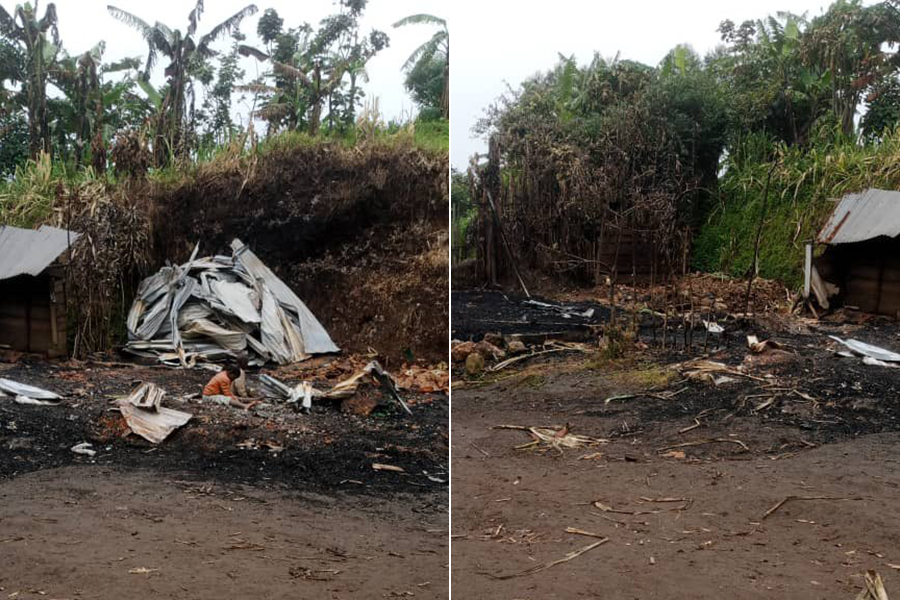
The M23 group has accused the government of the Democratic Republic of the Congo of carrying out systematic violence against civilians in the country’s east, alleging widespread bombardments in areas under its control in violation of a ceasefire framework.
In a lengthy statement shared on X on Friday, the group said the "genocidal" government in Kinshasa has chosen terror and massacres in a "strategy of violence against civilians".
The statement comes days after AFC/M23 announced the killing of its military spokesperson and field commander, Lt Col Willy Ngoma, alongside eight other combatants on Tuesday.
The circumstances surrounding their deaths have not been independently verified, but the group has blamed Congolese government forces for the attack, describing it as part of a broader offensive.
AFC/M23 alleged that “civilian populations of eastern Democratic Republic of the Congo, particularly those in areas liberated by AFC/M23, have been subjected to systematic violence of unbearable brutality.”
It accused coalition forces aligned to Kinshasa — including the Armed Forces of the Democratic Republic of the Congo (FARDC), the Democratic Forces for the Liberation of Rwanda (FDLR), Wazalendo militias, the Burundian army (FDNB), and what it termed “foreign mercenaries” — of carrying out “a campaign of terror, massacres, and horror, even as a ceasefire had been signed.”
The group directly accused President Félix Tshisekedi of undermining peace mediation efforts, saying he had “trampled all the efforts of peace mediators” and violated commitments reached under what it referred to as the Doha framework.
“Large-scale offensives have been launched in the east of the country, in blatant violation of international commitments by the Kinshasa regime,” the statement read.
“The massive use of drones and heavy artillery against densely populated villages has caused the deaths of women, children, and innocents. These acts constitute a flagrant violation of international humanitarian law and amount to assumed terrorist crimes.”
The reference to Doha relates to a ceasefire understanding reportedly reached in 2025 in Doha, Qatar, aimed at halting hostilities between Kinshasa and AFC/M23.
The Congolese government has not publicly acknowledged the rebel group’s latest allegations.
In a related development, M23 spokesperson Lawrence Kanyuka said attacks by Congolese government coalition forces on Thursday, February 26, reportedly killed a 19-year-old girl and 15 cows in Masisi territory in eastern DR Congo.
According to Kanyuka, the attacks on Mweso and Kitshanga were carried out by Kinshasa-backed FDLR elements. He condemned what he described as the “barbaric and despicable crimes committed every time [the government coalition] launch a generalised war, surfacing with shocking cruelty.”
He said FDLR militiamen deliberately target the “livelihoods of civilian populations in a logic of terror, collective punishment, and economic strangulation,” accusing them of attacking not only residents but also livestock in a region heavily dependent on cattle and subsistence farming.
The Kinshasa-backed FDLR is part of what M23 describes as a broader coalition formed by the Congolese armed forces, alongside the Burundi National Defence Force, Wazalendo militias and foreign mercenaries.
The February 26 attack in Masisi territory came as M23 accused Kinshasa of launching widespread operations in violation of the ceasefire agreed in Doha.
The movement said the reported offensives risk escalating the conflict and worsening what it described as an already fragile humanitarian situation in eastern DR Congo.
M23 also cited recent attacks in Rubaya, Kitendebwa, Kashihe and Kiduveri, areas it says have been subjected to drone overflights and bombardments.
In its main statement, the group provided a chronology of alleged assaults between January 15 and February 26, including:
- January 15: five successive bombardments around Minembwe (Point Zéro, Rwitsankuku, Baruta).
- January 17: attack on Point Zéro.
- January 22: bombardments on Rugezi and Biziba.
- January 24: bombardments at Mukoko and Gakenke, destroying several houses.
- January 29: continuous overflights and bombardments of Minembwe.
- February 16: attacks against Minembwe (Hauts Plateaux), Katoyi, and Mulumemunene.
- February 20: drone strikes and ground offensives at Minembwe.
- February 22: aerial and ground attacks, including what the group described as massacres of civilians in Nyaruhinga and Minembwe.
- February 23: bombardments on Gasovu, Nkokwe, Gatoyi, Minembwe.
- February 24: drone operations over Rubaya, Kitendebwa, Kashihe and Kiduveri in Kalehe territory.
- February 25: what it termed a “massive offensive” at Rutigita, Kitazungura and Rugezi.
- February 26: infiltration at the JTN tea plantation in Mweso and attacks against populations and livestock.
“The Kinshasa regime continues to violate the ceasefire through violence, massacres, and terror,” the group said. “No war is won by the blood of innocents. Neither media propaganda, nor diplomatic demonization, nor manipulation of public opinion can mask the truth or reverse history.”
The rebel movement also framed the conflict in ethnic and political terms, asking: “What do Tshilombo and his allies against the Tutsi, Banyamulenge, Swahili-speakers, and the inhabitants of areas under AFC/M23 control truly want?”
The Congolese government has consistently accused M23 of being backed by Rwanda, an allegation Kigali denies, and has in turn blamed the rebel group for destabilising eastern Congo and committing abuses against civilians. Independent verification of battlefield claims by either side remains difficult due to limited humanitarian and media access in conflict zones.
M23 first emerged in 2012 before being militarily defeated and resurfaced in 2021, subsequently capturing significant territory in North and South Kivu provinces.
The renewed fighting has displaced hundreds of thousands of civilians, according to United Nations agencies, and further strained regional relations in the Great Lakes region.
The reported killing of Lt Col Willy Ngoma, a prominent public face and battlefield commander of AFC/M23, represents a significant loss to the movement’s leadership structure.
Observers say his death, alongside eight other combatants, could signal a new phase of intensified confrontation between the rebels and Kinshasa’s coalition forces.
